A Sip of Gulp
Meet the Task Runner
Section titled “Meet the Task Runner”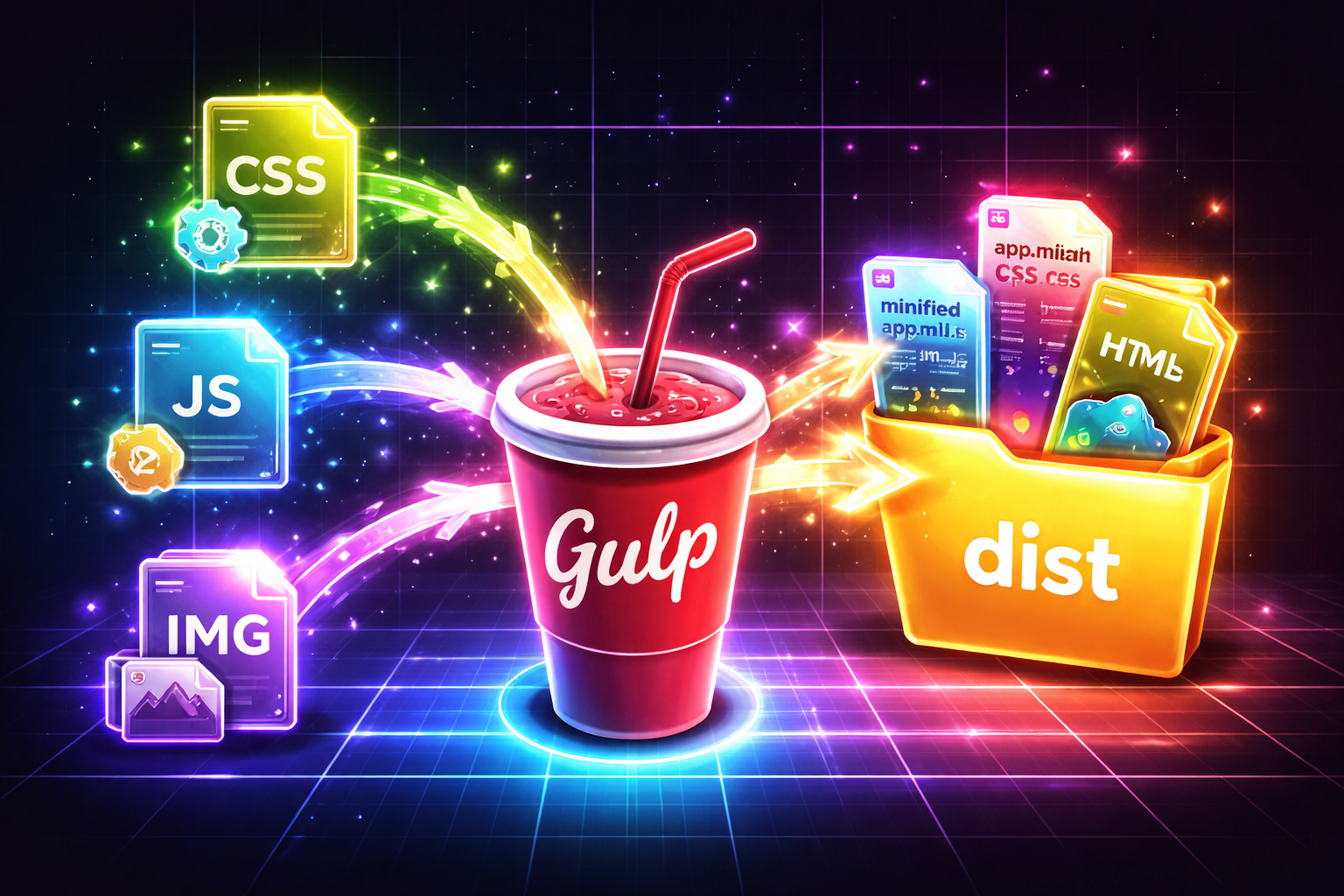
Gulp orchestrates your asset pipeline before deployment.
At some point, developers stopped asking:
“How do I remember to do all this?”
And started asking:
“Why am I doing this by hand at all?”
That question gave rise to task runners.
What Is Gulp?
Section titled “What Is Gulp?”Gulp is a task runner.
It doesn’t change your code.
It doesn’t understand your app.
It simply automates steps you already know how to do.
You define tasks.
Gulp runs them.
Every time.
The same way.
The Core Idea: Pipelines
Section titled “The Core Idea: Pipelines”At the heart of Gulp is a simple model:
files → transformations → output
Each task is a pipeline:
- read files from disk
- pass them through a series of steps
- write the result somewhere else
Nothing magical.
Just automation.
What Gulp Was Great At
Section titled “What Gulp Was Great At”In its time, Gulp solved very real problems:
- image optimization
- JavaScript concatenation
- minification
- copying files into a
dist/folder
Instead of doing these steps manually, you ran one command.
That was a huge win.
Why Developers Loved It
Section titled “Why Developers Loved It”Gulp felt:
- fast
- explicit
- predictable
You could open a gulpfile.js and see the entire build process.
No mystery.
No hidden behavior.
For a while, this was exactly what the web needed.
Important Framing
Section titled “Important Framing”Let’s be very clear:
- This is not a recommendation.
- This is not a modern default.
- This is not something you’re expected to adopt.
This is context.
Understanding Gulp helps you understand what came next.
A Controlled Taste
Section titled “A Controlled Taste”We’re going to take a very small sip:
- one
gulpfile.js - a few focused tasks
- no watchers
- no Sass
- no plugins beyond the essentials
Just enough to understand the model.
Then we move on.
⏭ Enter the Pipeline: A Minimal Gulp Build
Section titled “⏭ Enter the Pipeline: A Minimal Gulp Build”Let’s wire up a simple pipeline and see what “automation” looked like before modern platforms took over.